

Manhattan has kosher sushi options, but a late Midtown meal depends on the restaurant’s closing time. Midtown extends roughly from 30th to 59th Streets. A kosher sushi restaurant in Manhattan may suit your plans for dining in or taking food to go, depending on its hours and service format.
Hours matter, but so does the kind of Japanese meal you want. This guide focuses on kosher sushi in Manhattan, including dining, takeout, and delivery options. It also explains what to look for in sushi and other Japanese specialties, so you can choose a meal that suits your plans and meets Glatt Kosher standards.
Key Takeaways
- Plan a Midtown meal around the restaurant’s posted closing time, since late-night options depend on the day and service hours.
- Choose dine-in, pickup, or delivery based on how you want to enjoy your meal and where you’ll be eating.
- Look for kosher supervision in the kitchen, and explore Japanese specialties such as omakase, served one piece at a time.
- Discover Konata Sushi Bar as one option for sushi, alongside other dining choices from TALIA'S Brands.
Are there any kosher sushi places open late in Midtown?
Midtown Manhattan extends roughly from 30th Street to 59th Street. That boundary helps distinguish a Midtown address from restaurants farther downtown or uptown. Late dining, however, depends on each restaurant’s operating hours, not its neighborhood label. A Midtown location alone doesn’t establish whether its kitchen serves sushi late.
Use the full street address to assess location before planning dinner. Pin the restaurant on your route, then compare its position with your destination. For example, an address near 30th Street sits at Midtown’s southern edge; an address near 59th Street is at its northern edge. This distinction matters when choosing between a walk, a pickup stop, and delivery.
Hours can differ by weekday, weekend, and service type. A dining room may close at a different time from its pickup service, while delivery coverage may have its own cutoff. Check the listed hours for the exact date and the service you intend to use. For a late meal, confirm that the kitchen is still accepting sushi orders, rather than relying only on a dining-room closing time.
The Upper East Side is a separate Manhattan neighborhood, not another name for Midtown. An Upper East Side address may work for an uptown destination, but it shouldn’t be treated as a Midtown option. Compare the address with your plans before setting out, especially when time is limited.
Akimori is a name readers may encounter while exploring sushi options, but location and catering details should be tied to a specific address and service listing. For any restaurant, use these steps: locate the street address, match it to Midtown or the Upper East Side, and review the relevant hours. Then choose dining, pickup, or delivery based on the listed service. This method keeps the search focused on an actual route and a workable closing time, rather than assumptions based on a neighborhood name.
Dine-in, pickup, and delivery
Reservation procedures vary by restaurant. Kosher supervision concerns food preparation, while seating and reservations are handled separately. If you plan to dine in, use the restaurant’s booking option. For a spontaneous visit, review the current reservation and ordering options before you go.
Dine-in suits guests who want to enjoy sushi at the table, course by course. It also gives you time to review the menu and choose rolls, poke bowls, or other Japanese specialties. Pickup works better when you have a destination in mind, such as a hotel, office, or home. Select the pickup option when ordering, then follow the stated collection instructions.
Online ordering can make menu choices and service options easier to review before payment. Check the order summary for selected items, pickup or delivery, and the destination address. For example, a guest leaving Midtown may prefer pickup nearby, while someone staying in another Manhattan neighborhood may choose delivery if offered there. Delivery coverage and available times can vary by restaurant and location.
Takeout and delivery serve different needs. With takeout, you travel to collect the order; with delivery, the restaurant or ordering service brings it to the address provided. Before placing an order, confirm the selected service, the correct location, and any instructions shown at checkout. This helps prevent a dine-in order being mistaken for pickup or a delivery address being entered incorrectly.
First decide whether you want a table, a takeout order, or delivery. Then choose the matching option and review the details before confirming. Guests looking for sushi and other Japanese dishes can explore Konata Sushi Bar’s menu and select the format that suits their plans.
Kosher sushi and Japanese specialties
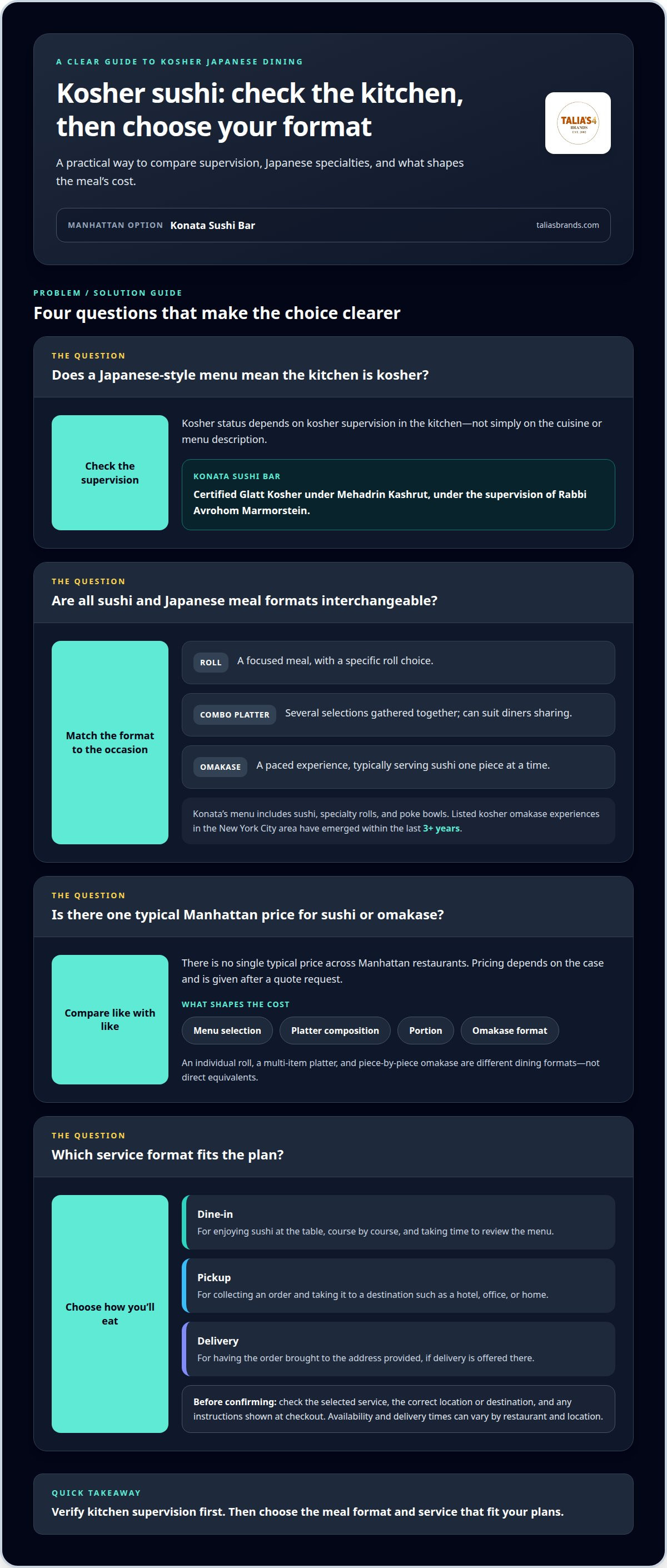
Kosher sushi depends on kosher supervision, not simply on a menu’s Japanese style. Konata Sushi Bar is certified Glatt Kosher under Mehadrin Kashrut, under the supervision of Rabbi Avrohom Marmorstein. Its menu includes sushi, specialty rolls, and poke bowls, offering different formats and flavors.
Japanese specialties also shape the dining experience. Omakase typically serves sushi one piece at a time, making the meal a sequence rather than a platter chosen all at once. In the kosher dining scene across the New York City area, listed kosher omakase experiences have emerged within the last 3+ years. This makes the format a relatively recent part of that local scene, distinct from ordering individual rolls.
What should you expect to pay for rolls, combo platters, or omakase? There is no single typical price across Manhattan restaurants; pricing depends on the case and is given after a quote request. The menu selection, platter composition, portion, and omakase format all shape the cost. Compare like with like: an individual roll, a multi-item platter, and a piece-by-piece omakase are different dining formats.
To choose, start with the occasion. A roll can suit a focused meal, while a combo platter gives diners several selections to share. Omakase fits guests who prefer a paced Japanese experience, with each piece served individually. Then review the menu’s named dishes and preparation descriptions. Specialty rolls and poke bowls provide alternatives to traditional roll choices, while kosher supervision remains the essential standard behind the kitchen’s offering. This approach helps match the meal’s format to your appetite, company, and preferred flavors without treating every Japanese dish as interchangeable.
Kosher sushi restaurants in Manhattan
Konata Sushi Bar is a Manhattan kosher sushi option for diners seeking Japanese cuisine. Its menu includes sushi, specialty rolls, and poke bowls. To find a kosher sushi restaurant in Manhattan, start with Konata Sushi Bar, then choose the dishes and service method that suit your plans.
Konata Sushi Bar is Glatt Kosher under Mehadrin Kashrut, led by Rabbi Avrohom Marmorstein. That gives diners a named standard and a named supervisory authority. Kosher sushi requires supervision in the kitchen, so the oversight applies to preparation, not merely the restaurant’s menu description. For guests comparing a kosher sushi restaurant in Manhattan, the relevant details are the supervising authority and the kitchen’s kosher status.
Menu variety matters, but ingredients and preparation are central too. Sushi, specialty rolls, and poke bowls differ in composition and presentation. Read the dish descriptions to understand what each option offers. For a group, specialty rolls can add variety; a poke bowl provides a different format for an individual meal.
Use a simple selection process. First, identify the restaurant and its kosher supervision. Next, choose the format: individual sushi, specialty rolls, or poke bowls. Then select dine-in, pickup, or delivery based on your plans. For example, a guest meeting friends may prefer shared rolls, while someone ordering a single meal may choose a poke bowl. The right option depends on the menu and the occasion, not on the neighborhood label alone.
For kosher sushi with several Japanese menu formats, explore Konata Sushi Bar’s sushi, specialty rolls, and poke bowls. Its Glatt Kosher status under Mehadrin Kashrut addresses the supervision question; the menu helps you decide what to order. Explore Konata Sushi Bar’s sushi menu and choose the format that suits your Manhattan plans.
TALIA'S Brands: Konata Sushi Bar
TALIA'S Brands brings the Manhattan search to a practical next step with Konata Sushi Bar. Choose it when you want sushi, specialty rolls, or poke bowls, with options for dining, takeout, and delivery. The menu offers distinct formats, whether you’re planning a focused meal or selecting several dishes for the table.
For a different meal within the same hospitality group, TALIA'S offers alternative options beyond Japanese cuisine. Each brand has its own culinary focus, while Konata Sushi Bar is the ideal fit specifically for sushi.
Order online from Konata Sushi Bar or reserve a table through TALIA'S Brands.
Make your next Manhattan meal easy to plan
Start with the format that suits your evening: a table, takeout, or delivery. Choosing a kosher sushi restaurant in Manhattan also means finding a menu that fits your appetite and the occasion. For sushi, specialty rolls, or poke bowls, explore Konata Sushi Bar at TALIA'S Brands.
The group also includes TALIA'S, West Side Wok, and Shawarma Shabazi, each offering a different dining direction. That range can help when your plans call for something beyond sushi, while keeping the decision focused on the meal you want.
Let the occasion guide your choice, whether you’re planning a quiet dinner or arranging food for others. Reach out to TALIA'S Brands to discuss kosher sushi and your dining plans. Contact TALIA'S Brands about kosher sushi, and take the next step toward a meal that feels well chosen.
Frequently Asked Questions
Which Midtown kosher sushi spots offer takeout?
Konata Sushi Bar offers takeout, but its Manhattan address is on the Upper West Side, not Midtown. TALIA'S Brands lists its restaurant brands at 668 Amsterdam Avenue, between 92nd and 93rd Streets. For a Midtown pickup plan, factor in the trip uptown before ordering. The group’s online ordering lets diners choose a takeout option and plan collection around their route.
Where are kosher sushi restaurants located in Manhattan?
Konata Sushi Bar is located at 668 Amsterdam Avenue, between 92nd and 93rd Streets, in Manhattan’s Upper West Side. This address places it uptown rather than in Midtown. For visitors navigating from another part of Manhattan, use the cross streets to orient your route. The same address also serves as the listed location for TALIA'S Brands’ other restaurant concepts.
What are the kosher sushi restaurants’ opening hours and days?
Opening days and hours depend on the restaurant and the service you choose. TALIA'S Brands states that Glatt Kosher food is available after midnight, but that timing should not be applied to Konata Sushi Bar. For a sushi order, use Konata’s online ordering option to view the current service window for your planned meal. A late-night listing for another brand does not establish sushi hours.
What are the menus and signature dishes at kosher sushi restaurants in Manhattan?
Konata Sushi Bar’s menu features sushi, specialty rolls, and poke bowls. These offer a choice of rolled sushi, specialty combinations, and a bowl-style meal. For a group, consider ordering specialty rolls alongside sushi; for an individual meal, a poke bowl is another option. Read the menu descriptions to compare the dishes.
Which Manhattan kosher sushi restaurants offer dine-in, takeout, delivery, or online ordering?
Konata Sushi Bar is part of a restaurant group offering prepared meals for dine-in, takeout, and online ordering, with delivery also available through the group. Online ordering is useful when you want to select the brand and service method before placing an order. For a table, use the group’s reservation option. Match the service to your plans, such as dining at the restaurant or ordering to an address.
Which Manhattan kosher sushi restaurants are best reviewed, and what do customers say?
When comparing reviews, look for current ratings and specific customer comments rather than relying on a single score. For sushi, consider feedback about freshness, order accuracy, service, and the dining experience. Separate delivery comments from dine-in feedback, since they describe different experiences, and look for recurring, concrete observations rather than claims that one restaurant is universally best.


