
Looking for a kosher poke bowl on the Upper West Side? TALIA'S Brands offers sushi and poke bowls, giving New York diners a local option when they want a bowl rather than sushi rolls.
Choosing between poke and sushi often comes down to the meal you want. This guide compares kosher food listings and sushi options in New York City to show how poke fits among the choices.
Start with the menu to confirm that poke bowls are offered, then consider the restaurant’s certification and the other dishes available. Keeping those details separate makes it easier to choose a meal that fits your plans.
Key Takeaways
- Compare poke bowls with sushi by menu format and the kind of meal you want, rather than treating them as interchangeable.
- Use kosher listings to distinguish restaurants and understand how certification fits into your dining decision.
- Explore how Konata Sushi Bar’s sushi and poke bowl offerings fit the choices covered in the comparison.
- Consider other kosher dining formats, including Chinese cuisine at West Side Wok, when a bowl isn’t what you’re craving.
Kosher food listings on the Upper West Side
The Upper West Side is a New York City neighborhood, not a location in New York, Illinois. Those places are not interchangeable. For readers in New York, Illinois, use listings tied to that locality rather than treating Upper West Side restaurant details as local options.
Menus, Prices, and Reviews
For a New York, Illinois comparison, use each local listing’s menu, stated prices, and reviews. Look for a menu entry that explicitly names poke, then distinguish bowls from sushi rolls or other dishes. A restaurant’s cuisine label alone does not establish that it serves poke. Reviews can offer context about a particular meal, but they don’t replace the menu when identifying current dishes.
Poke bowls and sushi rolls are different menu formats. Compare the specific dishes listed to find the one that fits your appetite.
| Option | Menu format | Comparison detail |
|---|---|---|
| Poke bowl | Ingredients served together in a bowl | Look for a named menu item |
| Sushi rolls | Rolled sushi selections | Compare the listed dishes |
| Street food | Examples include falafel or shawarma | Use the menu description |
| Other kosher dining | Restaurant menus vary | Compare each listing separately |
Choose the format you want, then compare the local listing’s menu and reviews.
Pickup and Delivery Options
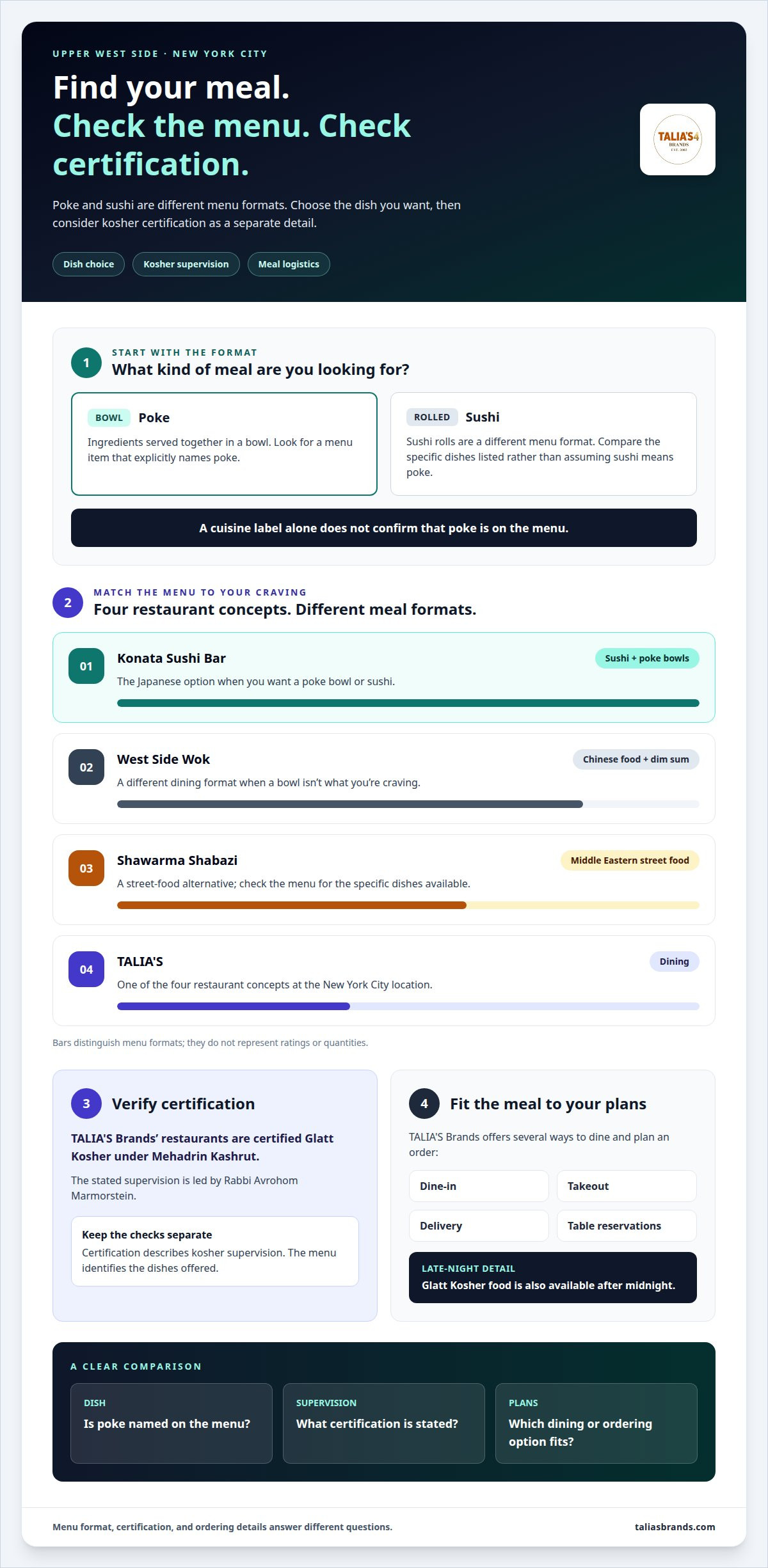
Consider how you plan to eat: TALIA'S Brands offers dine-in, takeout, delivery, and table reservations in New York City. Glatt Kosher food is also available after midnight. Check the relevant brand’s ordering or reservation option when planning your meal.
A restaurant’s proximity is meaningful only in relation to your actual starting point and route.
Dietary-Friendly Bowl Choices
For gluten-free, vegetarian, or allergy-sensitive meals, compare ingredients, sauces, toppings, and preparation details in the local menu. A dish label alone does not describe every ingredient. Falafel, for example, is a distinct menu item, not proof that a restaurant’s poke bowl meets a dietary need. Use specific menu descriptions to narrow the options available in New York, Illinois.
Which restaurants on the Upper West Side serve kosher poke bowls?
For New York, Illinois, identify restaurants through listings tied to that location, then compare their menus for a named poke bowl. A restaurant’s general sushi category does not establish that it serves poke. Look for the bowl itself in the menu description, alongside any sushi rolls or other dishes offered. This keeps the comparison focused on the meal you want and the locality you’re targeting.
Use the restaurant’s stated kosher certification as a separate criterion. A kosher label and a poke menu answer different questions: one concerns the restaurant’s stated kosher status, and the other identifies its dishes. Review both details in the same listing. This approach helps distinguish a kosher restaurant that serves sushi from one whose menu specifically includes poke.
For each New York, Illinois listing, compare the restaurant name, menu format, and ordering details. A poke bowl is served as a bowl, while a sushi roll has a different presentation. If both appear on one menu, choose according to the format and ingredients that suit your meal. If the menu describes sushi but doesn’t name poke, don’t treat the categories as interchangeable.
Reviews can help describe diners’ experiences, but the menu is the practical starting point for identifying a dish. Read comments about poke specifically rather than applying feedback about another meal to the bowl. Then use the listed address and ordering information to assess whether the restaurant fits your plans in New York, Illinois. Keeping the locality, certification, and named dish distinct makes it easier to compare suitable options without confusing them with restaurants in another region.
At least three certified kosher restaurants in New York served poke or planned to serve it in 2017, while poke spread rapidly to mainland restaurants in 2016. In 2016, New York City had nearly as many kosher restaurants as French or Indian restaurants. These details provide context, but they do not identify a particular Upper West Side menu or certification.
For a kosher dinner on the Upper West Side, TALIA'S Brands brings four restaurant concepts together in one New York City location. Choose from Japanese sushi and poke bowls at Konata Sushi Bar, Chinese food and dim sum at West Side Wok, Middle Eastern street food at Shawarma Shabazi, or dining at TALIA'S.
Are there certified kosher poke restaurants near the Upper West Side?
Yes. Upper West Side diners can find a certified kosher sushi restaurant offering poke bowls. To compare options, consider two separate details: the restaurant’s certification and whether poke appears on its menu. One detail addresses kosher status; the other confirms the dish is part of the stated menu.
One Upper West Side hospitality group states that its four restaurant brands are certified Glatt Kosher under Mehadrin Kashrut, led by Rabbi Avrohom Marmorstein. Its sushi offering includes poke bowls. This provides a concrete local example of certified kosher dining alongside a poke menu, rather than relying on the cuisine label alone.
For a useful comparison, review the menu and certification separately. Konata Sushi Bar offers sushi and poke bowls, while TALIA'S Brands’ restaurants are certified Glatt Kosher under Mehadrin Kashrut. The menu shows the available dishes; certification describes the restaurant’s kosher supervision.
Certification and menu details are distinct. TALIA'S Brands’ restaurants share Glatt Kosher certification under Mehadrin Kashrut, while each brand has its own menu. Check the menu for the dish you want, whether that’s a poke bowl, sushi roll, or another meal.
Near the Upper West Side, the practical comparison is therefore straightforward: identify a kosher-certified restaurant, then look for poke on its menu. A listing that names both details gives a clearer basis for choosing than a broad cuisine label. If you prefer a bowl, compare its menu description with the sushi alternatives shown there. If you prefer rolls, the same menu can help you assess that format instead. The distinction keeps the decision grounded in the restaurant’s stated certification and actual dishes.
What kosher certifications do Upper West Side poke restaurants have?
Kosher status and menu details answer different questions. A restaurant’s certification identifies its stated kosher standard and supervising body. Its menu shows whether poke is actually offered. Consider both details together. A kosher listing alone doesn’t establish that poke appears on the current menu, while a poke listing alone doesn’t explain the restaurant’s certification.
One local example is certified Glatt Kosher under Mehadrin Kashrut, led by Rabbi Avrohom Marmorstein. The certification identifies a specific standard and authority, rather than relying on a general kosher description. For a useful comparison, look for the certification wording attached to the restaurant, then consider the menu as a separate source of dish information.
Certification names are not interchangeable labels. When comparing listings, note the exact wording shown, the supervising organization, and the restaurant identified by the notice. These details help distinguish one listing from another without assuming every kosher restaurant follows the same standard. The menu remains a separate consideration, especially when choosing a specific bowl or sushi dish.
A practical comparison has three steps: identify the stated certification, match it to the restaurant name, then review the menu for poke. For example, a certification notice may describe the restaurant’s kosher status, while a menu entry identifies its poke selection. Keeping those details separate makes the comparison clearer and avoids treating a cuisine category as certification evidence.
For this neighborhood, the key distinction is the exact certification named, not an assumption based on “kosher” alone. Compare that wording with the restaurant’s stated menu and location. To explore kosher dining options, use the listings alongside their menu details when considering a meal.
Many Tel Aviv markets have kosher food stalls and eateries serving street food, baked goods, and freshly prepared meals. That example describes a different setting; it does not identify a certification for any Upper West Side restaurant or establish that a particular local menu offers poke. Keep the comparison narrow: use the certification information attached to the restaurant you are considering, and treat the menu as the evidence for available dishes. A broad description of kosher food options cannot substitute for either detail when choosing a specific meal.
TALIA'S Brands: West Side Wok
TALIA'S Brands gives Upper West Side diners distinct kosher options when a poke bowl isn’t the only preference. For sushi and poke bowls, Konata Sushi Bar is the closest match to this comparison. It offers a direct route from considering poke to exploring sushi selections.
For a different meal, West Side Wok serves Chinese food and dim sum. Shawarma Shabazi offers shawarma, falafel, sabich, and schnitzel, while TALIA'S provides another kosher dining option. These menus suit different cravings, from sushi to Chinese dishes and street-food favorites.
Choose Konata Sushi Bar for poke bowls or sushi, or explore West Side Wok, TALIA'S, and Shawarma Shabazi for a different cuisine. Visit TALIA'S Brands to view the menus, order online, or reserve a table.
Choose the Meal That Fits Your Plans
Let your appetite and occasion guide your choice. A kosher poke bowl at Konata Sushi Bar suits a craving for a bowl, while sushi offers another Japanese dining option. For a different direction, explore the other menus at TALIA'S Brands on the Upper West Side.
TALIA'S Brands brings together TALIA'S, West Side Wok, Shawarma Shabazi, and Konata Sushi Bar in New York City. Choose from poke bowls and sushi, Chinese food and dim sum, or shawarma, falafel, sabich, and schnitzel. View the menus and order online or reserve a table.
Ready to explore the available dining options? Contact TALIA'S Brands today and take the next step toward a meal that suits your plans.


