

Prime rib and kosher dining can share the same table. On New York City’s Upper West Side, TALIA'S is a kosher restaurant with prime rib, serving Glatt Kosher dining for a planned dinner.
Choosing where to dine is only part of the plan. You’ll also want practical details that help you arrive at the right time and understand the menu before settling in. Opening hours, contact information and price range all shape how easily dinner fits your schedule and budget.
This guide focuses on those planning essentials, along with what to consider when arranging a prime rib meal. It will help you orient yourself to the restaurant’s location, plan around its hours and approach pricing with a clearer idea of what affects the final cost. The result is a more composed start to an evening built around a generous cut, a polished dining experience and kosher standards.
Key Takeaways
- Use the restaurant’s location and opening hours to plan a visit that fits your schedule.
- Learn which menu and dining choices can shape the final cost, without relying on a one-size-fits-all estimate.
- Compare the beef cuts and prime rib preparations on offer to find a dish that suits your meal.
- Understand when arranging a reservation can make dinner planning smoother, and explore TALIA’S for a kosher prime rib meal.
Opening hours
Opening hours shape the dinner plan as much as the menu. In New York City, schedules may differ on Shabbat and Jewish holidays, so check the restaurant’s hours for your chosen date. A Thursday dinner and a Friday dinner can call for different plans. Use the schedule for that specific day rather than assuming every evening follows the same pattern.
Start with the date, then match your travel and dining plans to that day’s hours. For example, a guest arriving after work on Monday can plan differently from a family arranging dinner before Shabbat. Check the start and end of service, not just whether the restaurant is described as open. Kitchen service and dining-room access may not follow identical timings.
Holiday dates need their own attention. Jewish holidays can affect normal routines, so a schedule for an ordinary week may not apply to a holiday evening. If your visit falls near a holiday, use the date-specific hours shown on the restaurant’s official information. This helps you avoid planning around a typical weekday when the calendar calls for a different service schedule.
- Choose the date: Identify the weekday or holiday before arranging dinner.
- Read the service window: Note when dining begins and when the restaurant closes.
- Plan arrival: Allow time for travel through New York City and settling in before dinner.
- Coordinate the group: Share the same date and arrival plan with everyone attending.
For a prime rib dinner, timing also affects the pace of the evening. Arriving near the beginning of service can leave room to settle in and review the menu without rushing. A later arrival calls for a tighter plan around travel and ordering. Use the specific day’s schedule as the anchor, then arrange transportation and dinner companions around it. That simple sequence makes the evening easier to organize.
Price range
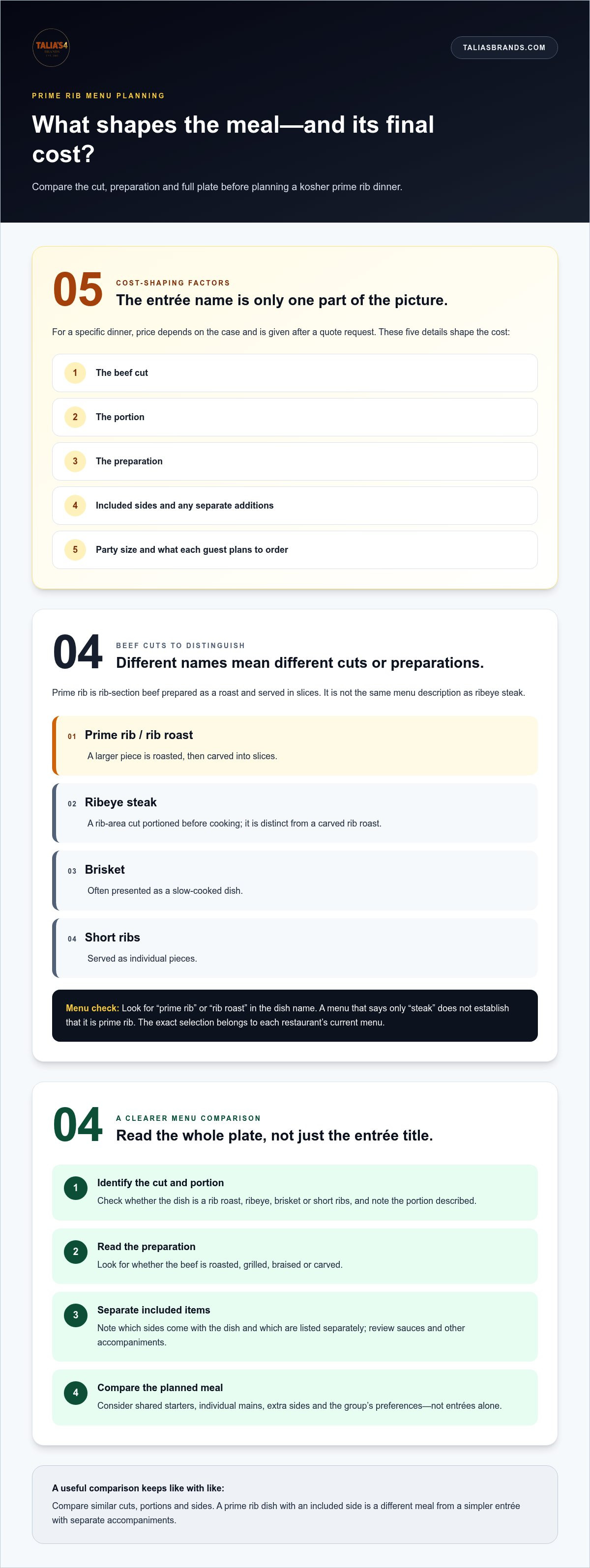
Prime rib pricing depends on what the meal includes, not only the name of the cut. A menu may list the beef as a standalone entrée, or present it with sides and accompaniments. Before comparing options, read the full dish description. Note the portion, preparation, included sides, and any listed additions. Those details make a comparison between two restaurant menus more useful than looking at the entrée name alone.
For a specific dinner, the price depends on the case and is given after a quote request; the cut, portion, preparation, sides, and party size shape the cost. A meal for one diner may involve different choices from a dinner planned for a group. Establish what each guest expects to order, then consider whether shared starters, individual mains, or additional sides fit the occasion. This gives you a practical basis for planning without relying on an assumed average.
- Read the menu description: Identify the portion and what accompanies the prime rib.
- Separate included items: Note which sides are part of the dish and which appear separately.
- Set the meal plan: Decide whether guests will order individually or share selected dishes.
- Review the total together: Consider every planned course, rather than comparing entrées alone.
A diner choosing prime rib with an included side is considering a different meal from one with separate accompaniments. Read the dish description to understand what is included. If the menu lists different cuts or preparations, compare similar portions and sides rather than treating a larger meal as equivalent to a simpler entrée.
For a kosher dinner, also keep the occasion and group’s preferences in view. A celebratory meal may call for a fuller menu than a straightforward dinner, while a smaller gathering may prefer fewer courses. Write down the intended dishes before settling on a plan. Clear choices make the eventual cost easier to understand and help align the meal with the evening you have in mind.
What cuts of beef and prime rib dishes are available at kosher restaurants?
Prime rib refers to beef from the rib section, prepared as a roast and served in slices. It isn’t the same menu description as ribeye steak, even though both come from the rib area. A menu might list a carved rib roast, a thick-cut ribeye, brisket, or short ribs. These names signal different cuts and preparations, so read the dish description rather than assuming every beef entrée is prime rib.
Preparation shapes the experience. A roast is cooked as a larger piece and carved, while a steak is portioned before cooking. Brisket is often presented as a slow-cooked dish, and short ribs are served as individual pieces. Menus can also pair beef with sauces or sides. For example, a sliced roast with vegetables offers a different meal from ribeye served with a separate accompaniment.
- Look for the cut: Distinguish rib roast from ribeye, brisket, and short ribs.
- Read the preparation: Note whether the beef is roasted, grilled, braised, or carved.
- Review the plate: Identify included sides, sauces, and other accompaniments.
- Match the meal: Choose a roast for carved slices or a steak for an individually prepared portion.
Kosher menus can feature familiar beef cuts, but the exact selection belongs to each restaurant’s current menu. For a prime rib dinner, look for “prime rib” or “rib roast” as the dish name. Then read the accompanying details for serving style and sides. A menu that simply says “steak” doesn’t establish that the dish is prime rib. Clear wording helps diners compare choices without confusing a cut with a cooking method.
For a group, compare preferences before choosing. One guest may prefer carved roast, while another may favor brisket or steak. Check whether the menu describes a dish as an individual entrée or part of a shared meal. That makes it easier for everyone to know what to expect.
Do kosher restaurants serving prime rib require reservations?
Reservation rules are set by each restaurant, so there isn’t one policy for every kosher dining room. A restaurant may accept bookings, welcome walk-ins, or use both approaches. For a prime rib dinner, a reservation gives the restaurant your planned arrival and party size. It also gives you a clear starting point for organizing the evening.
Consider the occasion before choosing how to book. A quiet dinner for two is simpler to arrange than a family gathering with varied arrival times. For example, if one guest is coming from work, agree on a meeting time before making the reservation. Share the correct party size and any seating needs when you book. That helps the restaurant prepare for your group.
Use these steps to make the plan straightforward:
- Choose the date and time: Settle on a slot that suits everyone’s schedule.
- Confirm the party size: Include each diner in the booking request.
- Keep the booking details: Save the confirmation and arrival time together.
- Update the plan: Tell the restaurant if your group size or timing changes.
For a special dinner, booking ahead is a practical way to structure the evening, even when reservations aren’t mandatory. It can be especially useful for a larger party, a holiday meal, or a popular dining period. A walk-in plan offers less certainty about timing and seating, so weigh that against your schedule. If your group has a fixed arrival time, a reservation creates a clearer plan than deciding at the last minute.
Before leaving, review your reservation details and the restaurant’s hours for that date. Share the booking name and arrival time with the person coordinating the group, and pass the details on to guests arriving separately. A simple plan helps everyone settle in smoothly.
TALIA'S Brands: TALIA'S
TALIA'S Brands is a natural fit for diners planning a kosher prime rib meal in New York City. TALIA'S serves Glatt Kosher dining and prime rib on the Upper West Side, with all offerings certified Glatt Kosher under Mehadrin Kashrut, supervised by Rabbi Avrohom Marmorstein.
Use the restaurant’s reservation option to organize your visit, then review the menu and practical details as you plan. If you’re coordinating a group with different tastes, the wider selection includes Konata Sushi Bar alongside TALIA'S, providing a distinct dining style.
Contact TALIA'S Brands to plan your visit.
Make your next dinner memorable
A memorable evening at a kosher restaurant with prime rib starts with choosing the experience you want to share. Consider whether you’re planning an intimate dinner, a family gathering or a meal for a group with varied tastes. That choice can guide your plans and make the evening feel considered.
TALIA'S Brands offers TALIA'S, West Side Wok, and Shawarma Shabazi, giving diners distinct kosher dining choices for different preferences. For a prime rib dinner, TALIA'S is the natural fit. The other options suit guests drawn to Chinese dishes or shawarma, so a group can explore a style that matches its appetite.
Give yourself a clear next step: settle on the dining experience, then get in touch to plan your visit. Contact TALIA'S Brands for details and take the first step toward a welcoming meal. Choose the occasion, gather your guests, and look forward to an evening worth sharing.
Frequently Asked Questions
Do any kosher restaurants serve prime rib in Jerusalem or Tel Aviv?
The kosher restaurant with prime rib featured here is in New York City, not Jerusalem or Tel Aviv. TALIA'S serves Glatt kosher prime rib at 668 Amsterdam Avenue in Manhattan. For visitors planning a New York meal, it’s a kosher restaurant with prime rib to consider while arranging their itinerary. The restaurant’s phone number is 212-580-3770, providing a direct way to discuss visit details.


