

Late-night sushi is only part of the decision. Kosher Japanese food in Manhattan brings together sushi, vegetarian choices, and omakase, where courses are typically served one piece at a time. If you’re looking for a kosher sushi option open late in Midtown, the practical question is where to find a suitable meal and what the menu offers.
Kosher sushi relies on kitchen supervision and excludes shellfish and the mixing of meat with dairy. This guide covers Japanese menu highlights, vegetarian selections, downtown dining options, nearby kosher restaurants, and the kosher omakase experience across New York City. You’ll have a clearer sense of what to expect and which details matter when choosing a meal.
Key Takeaways
- Explore Japanese menu styles and vegetarian choices to find a meal that suits your preferences.
- Use the downtown location and nearby dining options to plan a convenient Manhattan meal.
- Compare kosher restaurants by cuisine and dining experience to narrow down the right fit.
- Learn how kosher omakase works, including its one-piece-at-a-time sushi service and kitchen standards.
Menu highlights and vegetarian options
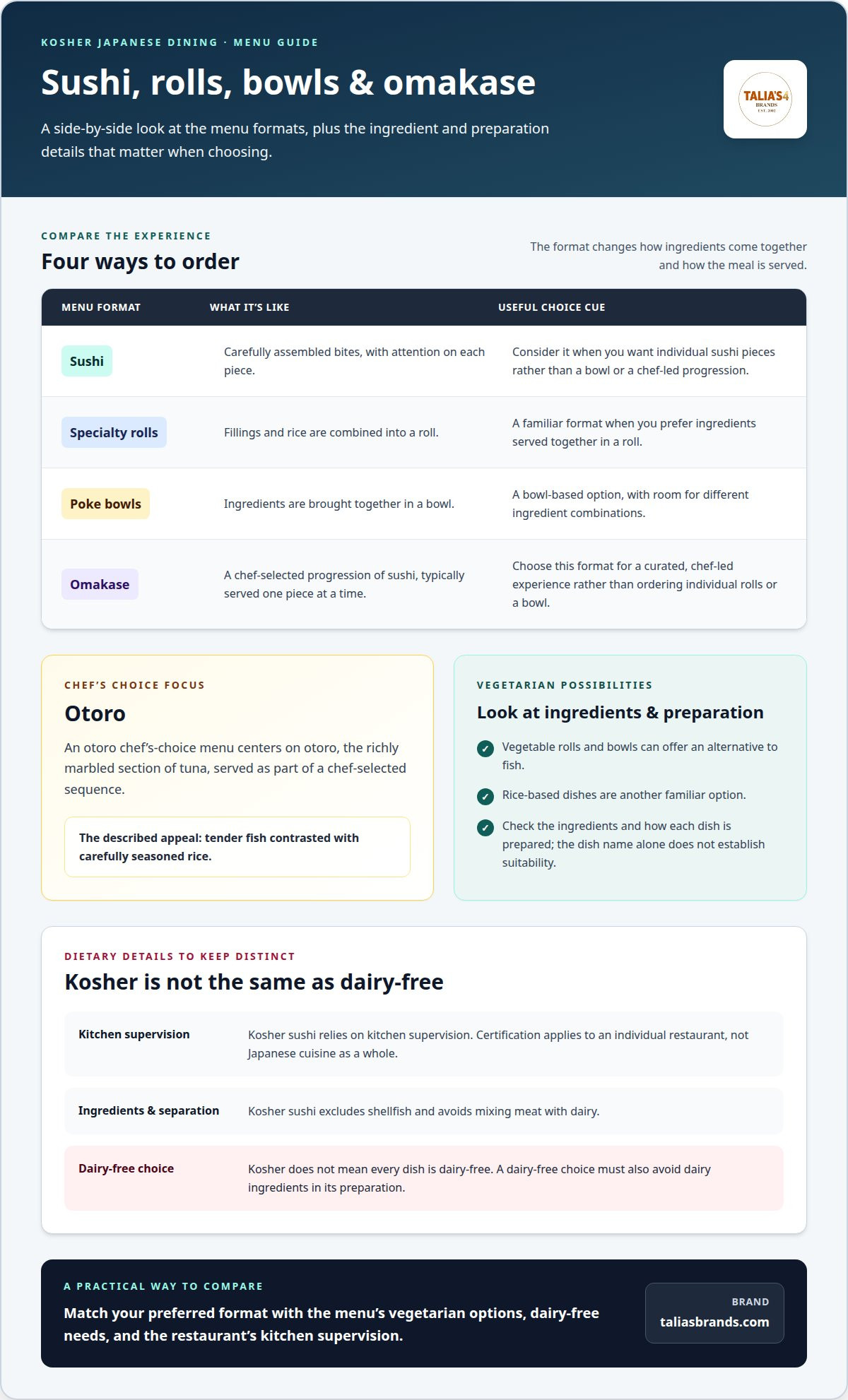
Kosher Japanese menus can feature sushi, specialty rolls, and poke bowls, each offering a different dining experience. Sushi emphasizes carefully assembled bites; rolls combine fillings and rice, while poke bowls bring ingredients together in a bowl. Omakase offers a chef-selected progression of sushi, typically served one piece at a time. These formats can suit guests seeking either a composed tasting experience or a more flexible meal.
Vegetarian choices depend on ingredients and preparation, not simply a dish’s name. Vegetable rolls and bowls can offer a satisfying alternative to fish, while rice-based dishes provide another familiar option. Kosher and dairy-free are not interchangeable terms: kosher dining excludes mixing meat with dairy, but that does not mean every kosher dish is dairy-free. A dairy-free choice must also avoid dairy ingredients in its preparation.
An otoro chef’s-choice menu centers on otoro, the richly marbled section of tuna, served as part of a chef-selected sequence. Its appeal lies in its focus and the contrast between tender fish and carefully seasoned rice. For kosher sushi, kitchen supervision is essential, and shellfish is excluded. These standards shape which ingredients can appear and how the menu is prepared, making supervision as important as the menu’s Japanese-inspired style.
Signature dishes and menu prices vary by restaurant and selection. A chef’s-choice progression differs from ordering individual rolls or a bowl; ingredients, portion, and menu format all affect the overall meal. Without a supported price list, no specific amount should be assumed. To compare options, consider whether the menu offers vegetarian selections, whether dairy-free choices fit your needs, and whether you prefer a curated omakase or familiar sushi formats. These details make the menu easier to match to the occasion.
Restaurant location in downtown Manhattan
For Japanese dining in Manhattan, start with the restaurant’s address and your destination, whether that’s work, a hotel, or another stop. A neighborhood name alone doesn’t identify the entrance or the closest transit connection. Map the final walk and consider the route from where you’ll be starting. This is especially useful downtown, where even a short distance can involve several blocks.
Which Japanese restaurants in Manhattan are kosher-certified? Certification applies to an individual restaurant, not to Japanese cuisine as a whole. A restaurant’s name and location alone don’t establish its kosher status; that status depends on the supervision governing its kitchen. Akimori is one name readers may encounter while comparing locations, but a useful comparison also needs the specific branch and its supervision details.
What are the addresses and neighborhoods of kosher Japanese restaurants in Manhattan? Options may be described by areas such as downtown or the Upper West Side, but those labels aren’t street addresses. For a practical itinerary, pair the restaurant’s address with its neighborhood and nearest subway stop. This makes it easier to compare locations without assuming they share the same transit access.
What are the opening hours, and are any locations open on Shabbat or Jewish holidays? Restaurant hours are venue-specific, and Shabbat and holiday schedules differ from ordinary weekday service. The date matters as much as the location, so a regular-hours listing doesn’t describe holiday service.
Do kosher Japanese restaurants in Manhattan require reservations? Reservation policies are set by each restaurant and can vary by service style. A seated meal and a chef-led omakase experience may call for different planning, so consider reservations when choosing a location. Map the address first, then plan around the restaurant’s stated schedule.
Comparisons with nearby kosher restaurants
Are there kosher Japanese restaurants near Midtown, the Upper West Side, or other Manhattan neighborhoods? When comparing kosher Japanese food in Manhattan, start with each restaurant’s address rather than assuming options are evenly distributed. Midtown, the Upper West Side, and downtown are distinct itinerary areas. Compare the address with your plans, such as a hotel, meeting, or evening destination.
Next, compare cuisine and service style. A Japanese restaurant may focus on sushi, rolls, or a chef-selected sequence, while another kosher restaurant may serve a different cuisine. That choice shapes the dishes, pace, and variety available to your group. Kosher Japanese food in Manhattan may suit guests seeking a focused sushi meal; another cuisine may better fit a group with varied preferences.
Menu creativity is only one consideration. Kosher supervision and the restaurant’s actual menu matter too. Compare the supervision associated with the specific restaurant, not merely its cuisine or neighborhood. Sushi and other menu styles involve different ingredient selections and preparation needs, even when they fit the same outing.
Make the comparison practical: identify the neighborhood, map the restaurant address, consider the menu format, then factor in timing and reservations. Midtown may suit plans centered there, while an Upper West Side address may work better for a visit in that area. Downtown may fit a separate itinerary. These distinctions help guide your choice. For kosher Japanese food in Manhattan, match the location and dining style to your plans.
Kosher omakase in New York City
Omakase offers a chef-led way to experience sushi: pieces are typically served one at a time. That measured pace makes each course part of the setting, rather than simply a selection from a menu. Across New York City, kosher omakase options are covered across the five boroughs and New Jersey. For Manhattan diners, the takeaway is to consider both the chef’s approach and the location before planning an evening.
Kosher standards shape the experience from the kitchen outward. Kosher sushi requires kitchen supervision, excludes shellfish, and avoids mixing meat with dairy. These requirements affect ingredient choices and preparation, distinguishing kosher omakase from a Japanese-style meal that may use similar presentation without the same standards. Supervision is as central to the choice as the chef’s sequence of fish and rice.
Not every Japanese tasting format is traditional omakase. Nikkei cuisine, for example, fuses Japanese and Peruvian cultures, bringing a different influence to the meal. Understanding that distinction helps guests decide whether they want a sushi progression or a broader fusion setting. Menu style, ingredient selection, and course pacing all shape the experience, so a format’s name alone doesn’t tell the whole story.
For a Manhattan visit, first decide whether a chef-selected sequence suits the occasion. Then weigh the restaurant’s location, supervision, and stated menu style. A one-piece-at-a-time progression creates a different rhythm from ordering several rolls or sharing plates. These practical details help match the meal to the evening, whether the priority is focused sushi or a more varied Japanese-Peruvian influence. For a kosher sushi dining option, explore sushi dining choices.
TALIA'S Brands
TALIA'S Brands brings several kosher dining styles together for Manhattan guests deciding what to eat. For Japanese cuisine, Konata Sushi Bar offers sushi, specialty rolls, and poke bowls. TALIA'S and its companion brands offer different dining styles, featuring classic favorites and comforting options. This range helps guests choose a meal that fits their plans, whether they’re drawn to sushi or prefer another cuisine, all while searching for authentic kosher Japanese food Manhattan options.
The brands within the group are under strict Glatt Kosher supervision, providing a reliable standard of kashrut for local diners. This shared standard offers a clear point of reference when comparing menus across the group. Choose Konata Sushi Bar for Japanese-inspired dining, or explore the other brands for a distinct menu and style to satisfy your cravings.
For help choosing a Manhattan meal, explore TALIA'S Brands’ menus and order online today.
Make your next meal a considered choice
Planning kosher Japanese food in Manhattan starts with the kind of meal you want: a focused sushi selection, a relaxed dinner, or a gathering with varied tastes. Let the occasion guide your choice, then consider which menu and neighborhood fit your plans. A thoughtful match makes the meal feel intentional, not simply convenient.
TALIA'S Brands brings together TALIA'S, West Side Wok, Shawarma Shabazi, and Konata Sushi Bar, offering distinct kosher dining options, including Japanese cuisine. Choose the experience that suits your guests and the occasion. Explore the menus and order online for your next meal.
Contact TALIA'S Brands to discuss your dining plans. A well-chosen meal is a welcoming place to begin.
Frequently Asked Questions
Are there any kosher sushi places open late in Midtown?
TALIA'S Brands offers open-late Glatt Kosher service in New York, but that doesn’t establish late-night sushi service in Midtown. Konata Sushi Bar is at 668 Amsterdam Avenue, between 92nd and 93rd Streets, on the Upper West Side. Its address is not in Midtown, and the available information gives no specific closing time. Plan by distinguishing late-night service from sushi-specific hours.
What kosher sushi delivery options are available in Midtown?
TALIA'S Brands offers delivery and online ordering, including Konata Sushi Bar’s Japanese menu. For a Manhattan meal, enter your destination in the ordering flow to see whether delivery serves that address; a restaurant’s location alone doesn’t define delivery reach. Takeout is another option. Choose the order format before selecting sushi, specialty rolls, or poke bowls.
Which Midtown kosher sushi spots offer takeout?
TALIA'S Brands offers takeout, and Konata Sushi Bar serves sushi, specialty rolls, and poke bowls. Konata is on the Upper West Side, so plan for pickup from its Manhattan address rather than Midtown. The group also offers online ordering. Selecting pickup can help organize a meal when your plans take you elsewhere in Manhattan.
What kosher certification does each Manhattan Japanese restaurant have?
All four TALIA'S Brands restaurants, TALIA'S, Shawarma Shabazi, West Side Wok, and Konata Sushi Bar, are under the strict Glatt Kosher supervision of Mehadrin Kashrut, led by Rabbi Avrohom Marmorstein. This supervision applies to the group’s four brands, not every Japanese restaurant in Manhattan. Kosher status depends on the supervision governing each restaurant, not its cuisine or neighborhood.
What Japanese dishes are available, such as sushi, ramen, and tempura?
Konata Sushi Bar’s Japanese offerings include sushi, specialty rolls, and poke bowls. These give diners options across sushi selections, rolled dishes, and bowl-style meals. Ramen and tempura shouldn’t be assumed as available from those menu highlights. For a group with different preferences, consider which of the listed formats best suits the meal and the occasion.
What are the menus and current prices at kosher Japanese restaurants in Manhattan?
Konata Sushi Bar features sushi, specialty rolls, and poke bowls. For current prices, use the restaurant’s active menu during ordering rather than relying on an older listing. The total depends on the dishes selected, so compare the specific items you’re considering. No price estimate should be treated as current unless it appears on the active menu.


