
In New York, start by checking who supervises a restaurant and what its kosher certification covers. To understand how to choose a Glatt kosher restaurant, look beyond the word “Glatt” and review the certificate and its scope. Treat the label as a starting point, not the whole decision.
It’s reasonable to want both a meal you’ll enjoy and confidence that the kitchen follows the standards you observe. Supervision can differ, and details such as meat handling, baked goods, and on-site oversight may matter to your choice.
This guide explains how to read kosher certification, compare supervision standards, and ask focused questions about a restaurant’s practices. You’ll also learn what to look for in meat and baked-goods supervision and how to assess whether a certification suits your needs. With a clear checklist, you can make an informed choice and enjoy your meal with greater peace of mind.
Key Takeaways
- Read the restaurant’s kosher certificate and identify which authority supervises the kitchen.
- Compare Rabbanut and Mehadrin standards against the level of supervision you observe.
- Ask focused questions about meat, baked goods, and the presence of a mashgiach.
- Check that the certification covers the occasion, especially when dining during Passover.
1. Checking supervision for meat and baked goods
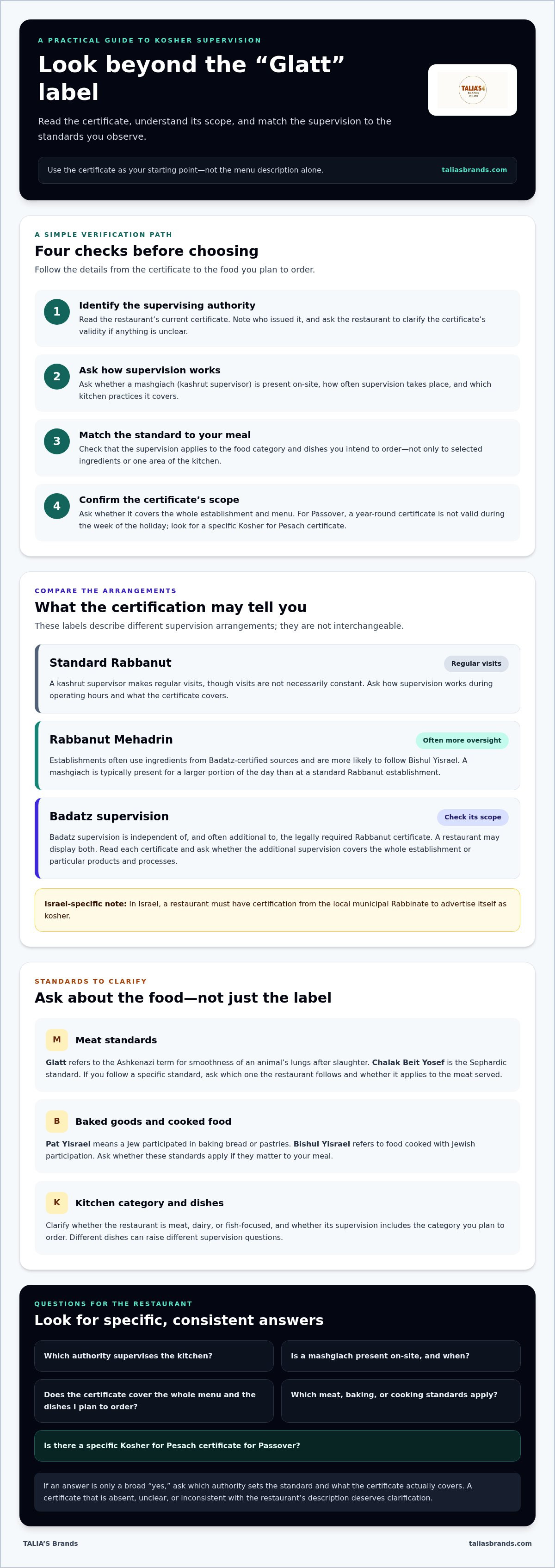
Start with the restaurant’s current kosher certificate and identify the supervising authority. Then ask whether a mashgiach, or kashrut supervisor, is present on-site consistently. Restaurants supervised by Badatz Eidah HaChareidis use certified products and constant supervision. For New York diners, the same practical checks apply: identify the authority and ask what its supervision covers. A meat restaurant or grill should be able to explain its meat supervision, not simply describe its menu as kosher.
“Glatt” and “Chalak Beit Yosef” refer to different meat standards. Glatt is the Ashkenazi term for smoothness of an animal’s lungs after slaughter; Chalak Beit Yosef is the Sephardic standard. If you follow a specific standard, ask which one the restaurant follows and whether it applies to the meat served. This distinction can guide your choice between meat dining and other options.
Restaurant categories also shape the meal. A meat restaurant serves meat, while a dairy restaurant serves dairy foods; a fish-focused menu is another option. Ask how the restaurant classifies its kitchen and how it handles the category you plan to order. A grilled meat dish, a dairy pastry, and fish each raise different supervision questions. Menu flavors matter, but the certificate and kitchen standards establish the basis for dining.
For baked goods, ask whether bread and pastries are Pat Yisrael, meaning a Jew participated in baking them. Bishul Yisrael refers to food cooked with Jewish participation, so ask about it if that standard matters to your meal. A useful final step is to ask whether the on-site supervisor covers the food you intend to order. If your visit is near sunset, check the restaurant’s opening hours separately; hours do not establish its kashrut standard.
2. Rabbanut and Mehadrin certification
Rabbanut and Mehadrin describe different supervision arrangements, not interchangeable labels. Standard Rabbanut certification involves regular visits by a kashrut supervisor, though those visits aren’t necessarily constant. For New York diners comparing a restaurant’s stated standards, begin with the certificate’s issuing authority and ask how supervision works during operating hours. The wording can help distinguish formal certification from a general description on a menu or website.
Rabbanut Mehadrin establishments often use ingredients from Badatz-certified sources and are more likely to follow Bishul Yisrael, which involves Jewish participation in cooking. A mashgiach is typically present for a larger portion of the day than at a standard Rabbanut establishment. Ask which standards apply to the food you plan to order. A cooked entrée and a packaged ingredient, for example, may involve different supervision details.
Badatz supervision is independent of, and often additional to, the legally required Rabbanut certificate. A restaurant may therefore display both certificates. Read each one for its issuing authority and scope. Then ask whether the additional supervision covers the entire establishment or particular products and processes. This distinction helps you understand multiple certificates without assuming they mean the same thing.
When considering how to choose a Glatt kosher restaurant, compare the named authority and supervision practices with the standard you personally follow. Ask which authority supervises the restaurant, whether a mashgiach is present, and how the certificate applies to the kitchen. These questions help New York diners assess a restaurant that references Rabbanut, Mehadrin, or Badatz standards. How to choose a Glatt kosher restaurant comes down to understanding what each certificate represents, rather than relying on a broad label. Menu style, from a casual meal to a formal dinner, does not by itself establish the level of kashrut supervision.
3. Questions to ask a restaurant
Ask which authority supervises the kitchen and whether its certification is Mehadrin. Then ask whether a mashgiach is present on-site and what the supervision covers. In Israel, a restaurant must have certification from the local municipal Rabbinate to advertise itself as kosher. A clear answer should identify the authority and explain which parts of the kitchen and menu fall under its supervision.
To check whether a certificate is current and covers the whole menu, review the displayed certificate and ask the restaurant to clarify its validity and scope. Confirm that the named authority supervises the dishes you plan to order, not just selected ingredients or one kitchen area. During the week of Passover, a year-round certificate isn’t valid; the restaurant needs a specific Kosher for Pesach certificate.
For vegan, gluten-free, or allergy-related needs, ask which dishes meet your requirements and how the kitchen prepares them. Request details about ingredients, substitutions, and shared equipment or preparation areas, then match the answers to your dietary needs. A menu that offers salads or seasonal vegetable dishes doesn’t establish that those dishes meet a particular dietary requirement.
Listen for precise answers. A staff member should be able to identify the supervising authority and explain how to view the certificate. If the answer to “Is the restaurant Mehadrin?” is simply “yes,” ask which authority sets that standard. A certificate that’s absent, unclear, or inconsistent with the restaurant’s description deserves clarification. So does uncertainty about whether the displayed certification covers the whole menu.
Before deciding, compare the answers with the dishes you want, the restaurant’s stated certification, and your own standards. For a menu with meat, dairy, or fish options, ask whether the kitchen’s supervision includes the category you’re ordering. These direct questions make it easier to distinguish a broad kosher claim from a specific, understandable standard.
4. How can I verify a restaurant's Glatt kosher certification in Israel?
Begin with the certificate displayed at the restaurant. Israeli law requires a restaurant to be certified by the local municipal Rabbinate to advertise itself as kosher. Check that the certificate names the establishment you’re visiting and identifies the authority responsible for supervision. A verbal claim or menu description isn’t a substitute for seeing the certification.
Next, read the certificate’s wording carefully. Look for the supervising authority and the standard it represents, including whether the restaurant describes its supervision as Mehadrin or Glatt. These terms should be connected to a named certification authority, not appear only in promotional language. If the certificate is difficult to read, ask staff to show you a clearer copy.
Then clarify the certificate’s scope. Ask whether it covers the restaurant’s full kitchen and menu, including the dishes you intend to order. If a restaurant serves meat, dairy, or fish options, ask whether those categories fall under the same supervision. A clear answer should identify any distinctions rather than treating a displayed certificate as proof that every menu item has identical supervision.
Check the certificate’s validity information and compare the establishment name with the restaurant’s current name. If the restaurant says its standard is Mehadrin or Glatt, ask which authority supervises that standard. During the week of Passover, a year-round kosher certificate is invalid; restaurants need a specific Kosher for Pesach certificate. The relevant certificate must cover the occasion.
Finally, compare what you see with what staff explain. A mismatch between the certificate, the restaurant’s name, and its stated supervision calls for a direct question. Ask who supervises the kitchen and which authority issued the certificate. For a careful decision, note the authority and scope, then assess them against your own kashrut requirements. This simple sequence helps you distinguish certification from a general kosher claim.
TALIA'S Brands: TALIA'S
TALIA'S Brands offers a natural next step for diners seeking Glatt kosher dining under Mehadrin supervision. Its New York restaurants are certified Glatt Kosher under Mehadrin Kashrut, led by Rabbi Avrohom Marmorstein. Choose TALIA'S for a sit-down meal, or Konata Sushi Bar for sushi and specialty rolls. Each offers a distinct dining style within the group’s stated kosher standard.
After comparing certification details with your own requirements, explore the menu that suits the occasion. TALIA'S brings together the confidence of established supervision and a considered restaurant experience. Visit TALIA'S Brands’ restaurant offerings to explore the dining options, or contact TALIA'S Brands with your questions.
Make Your Next Meal a Confident Choice
Let your standards guide the occasion, then choose a dining experience that suits the company, mood, and meal you have in mind. The best choice is one where both the food and supervision feel right for you. That’s the practical heart of how to choose a Glatt kosher restaurant: make an informed decision, then enjoy the meal without second-guessing it.
TALIA'S Brands brings several distinct dining options together in New York, including TALIA'S, West Side Wok, and Shawarma Shabazi. Whether you’re considering a polished dinner, Chinese dishes, or shawarma, explore the menus and choose what fits your plans. Browse the offerings and select the experience that appeals to you.
Contact TALIA'S Brands today to explore your dining options. Choose with confidence, and look forward to a meal that feels right for you.
Frequently Asked Questions
What does Glatt kosher mean, and how does it differ from regular kosher?
Glatt describes a particular standard for meat, not a separate category covering every aspect of a restaurant’s kitchen. The term refers to smooth lungs after slaughter in the Ashkenazi tradition; Chalak Beit Yosef is a Sephardic meat standard. “Kosher” alone describes compliance with kashrut requirements but doesn’t tell you which meat standard or level of supervision applies. Check the restaurant’s certificate and ask what standard it covers.
Which Israeli kosher certification agencies are considered reliable for Glatt restaurants?
Start with the local municipal Rabbinate, whose certification is required for a restaurant in Israel to advertise itself as kosher. Some establishments also display supervision from a Badatz authority, such as Badatz Eidah HaChareidis. Rather than relying on a general ranking, identify the authority named on the certificate and ask whether it supervises the restaurant’s full operation. The relevant standard is the one that matches your own kashrut practice.
What is the difference between Chief Rabbinate, mehadrin, and private Glatt certification?
In Israel, local municipal Rabbinate certification is the required basis for advertising a restaurant as kosher. Mehadrin generally signals a stricter supervision approach, but the exact standard depends on the authority. Private Badatz supervision is independent of, and often additional to, the Rabbanut certificate. Read both certificates if displayed, then ask what each covers. A “Glatt” label alone doesn’t identify the supervising body or explain its practices.
What questions should I ask a Glatt kosher restaurant about meat, poultry, and kitchen supervision?
Ask which authority supervises the restaurant, which meat standard it follows, and whether the certificate covers poultry and the dishes you plan to order. For example, ask whether the supervisor’s oversight includes receiving ingredients and kitchen preparation, rather than assuming the menu label answers that. You can also ask whether a mashgiach is present during service. Clear, specific answers help you compare the restaurant’s practices with your requirements.


